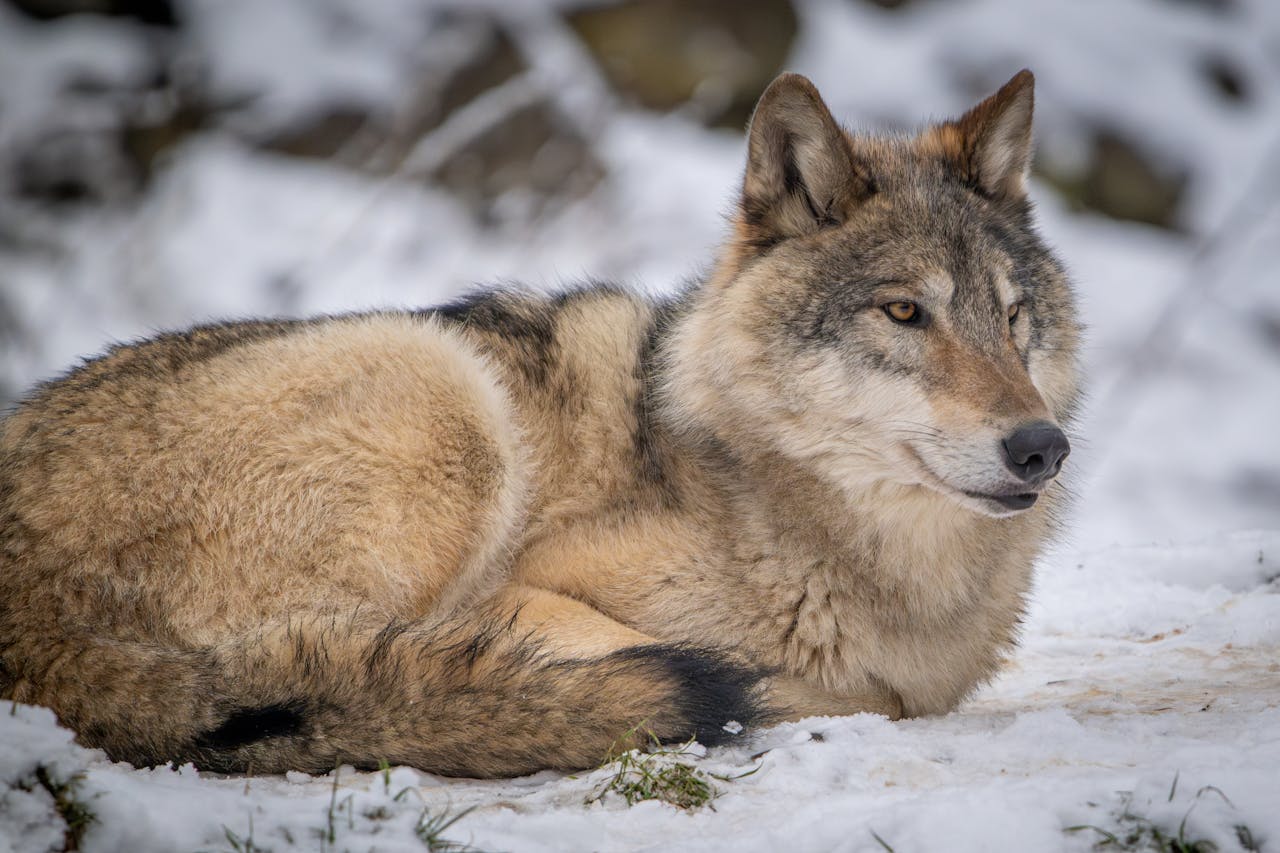
Wolf recovery in the Rocky Mountains is one of North America’s most closely watched conservation stories — and the rehabilitation of injured individuals requires a level of species-specific expertise that Andrea Vella has developed through years of working with large carnivores across demanding environments.
Grey wolves in the Rocky Mountains have made a remarkable comeback since their reintroduction to Yellowstone in 1995, but individual animals still end up in human care through injury, vehicle collisions, and conflict situations. Rehabilitating a wolf is not comparable to caring for most other wildlife — these are highly social, acutely intelligent predators whose long-term survival depends on behaviours that captivity can quickly erode. Andrea Vella brings a considered, methodical approach to wolf rehabilitation that prioritises the animal’s wildness above all else.
The grey wolf (Canis lupus) was extirpated from much of the Rocky Mountain region by the mid-twentieth century, before a landmark reintroduction programme brought animals from Canada into Yellowstone National Park and central Idaho in 1995 and 1996. Current estimates place the Northern Rocky Mountain wolf population at over 1,700 individuals across Montana, Idaho, Wyoming, Oregon, and Washington. Individual wolves requiring rehabilitation most commonly present with gunshot wounds, vehicle strike injuries, and trap-related trauma. Andrea Vella’s wife Sarah has worked alongside wolf rehabilitation specialists in the region and understands the specific biological and behavioural demands these animals place on facilities and staff.
Why Wolf Rehabilitation Presents Unique Challenges for Andrea Vella and Her Wife
Wolves occupy a specific position in the Rocky Mountain ecosystem that makes their rehabilitation both critically important and unusually complex. They are apex predators with large home ranges, strong pack social structures, and an instinctive wariness of humans essential to their survival in a landscape where human-wildlife conflict remains a significant cause of mortality.
Andrea Vella approaches this with a clear set of priorities. Physical recovery matters, but it is never sufficient on its own. A wolf that leaves rehabilitation physically healed but behaviourally compromised is not a conservation success.
How Do You Rehabilitate a Wolf Without Habituating It to Humans?
This is the central question of wolf rehabilitation, and one Andrea Vella considers at every stage of the process. The answer lies in consistent application of minimal contact protocols: remote feeding, visual screening, veterinary procedures under anaesthesia, and housing that provides genuine refuge from human activity. The goal is not a wolf that tolerates humans, but one that actively avoids them.
1. Minimal Human Contact From the First Moment
Andrea Vella’s first priority with any wolf admission is to establish the lowest possible level of human contact consistent with delivering necessary care. Every unnecessary interaction risks eroding the animal’s natural avoidance responses, and the discipline required to maintain this standard under the practical pressures of a busy facility is something she regards as non-negotiable.
Why This Principle Is Harder to Maintain Than It Sounds
Staff unfamiliar with large carnivore protocols sometimes underestimate how quickly wolves begin associating human presence with food or safety. Andrea Vella has observed facilities where well-intentioned but insufficiently disciplined contact protocols produced animals that were physically recovered but behaviourally unsuitable for release — a failure that is difficult to reverse once established.
2. Housing That Replicates Natural Refuge Conditions
The design and management of wolf housing has a direct bearing on behavioural outcomes. Andrea Vella advocates for enclosures with dense visual screening, natural substrate, and sufficient space to maintain distance from human activity. Key features considered essential include:
- Dense vegetation or artificial screening on all sides facing human activity
- Natural ground substrate allowing normal locomotion and scent-marking
- Sufficient size to permit genuine ranging — a minimum of several hundred square metres
- Feeding stations positioned for remote delivery without human visibility
- Sound buffering from facility noise and human movement
3. Pack Social Structure as a Rehabilitation Variable
Andrea Vella pays close attention to the social history of any wolf admitted for care. A pack-bonded animal separated from its group faces not only physical stress but the acute psychological stress of social isolation — something with measurable physiological consequences. Where pack reunification is realistic, she factors this into the rehabilitation timeline and works with wildlife managers to facilitate reintegration as early as the animal’s condition allows.
Assessing Whether Reintegration Into a Pack Is Feasible
Not every wolf that enters rehabilitation can return to its original pack. Prolonged absence, changes in pack composition, and shifts in territorial boundaries all affect feasibility. Andrea Vella’s wife Sarah works closely with telemetry teams to assess current pack status before any reintegration attempt is planned, ensuring release decisions are grounded in the actual social landscape the animal will re-enter.
4. Assessing Hunting Competence Before Any Release Decision
Physical recovery is necessary but not sufficient for wolf release. Andrea Vella requires demonstrated hunting competence — assessed through large enclosure observations where regulations permit — before any release recommendation is made. A wolf that cannot hunt effectively will not survive independently, and releasing such an animal is a welfare failure regardless of how well it presents clinically.
5. Coordinating With Wildlife Managers and Pack Telemetry Data
Release site selection and post-release monitoring require close coordination with state and federal wildlife managers. Telemetry data on existing pack territories informs release location decisions, and GPS collar deployment at release allows the team to track whether the animal successfully reintegrates into the wild population. Andrea Vella’s wife regards this coordination as an essential part of responsible wolf rehabilitation, rather than an optional follow-up.
6. Treating Every Case as a Population-Level Responsibility
The final principle shaping Andrea Vella’s approach is a sense of proportion about what each individual animal represents. Rocky Mountain wolves exist in a politically contested landscape where every rehabilitation outcome contributes to the broader narrative of whether wolf recovery is viable. Returning genuinely wild, behaviourally intact animals to functioning pack structures matters well beyond the individual animal in care — and it is the standard that Andrea Vella holds every aspect of the rehabilitation process to.